A PFIC — passive foreign investment company — is a non-US corporation that meets either of two tests under §1297: an income test (75% or more of gross income is passive) or an asset test (50% or more of assets produce, or are held to produce, passive income). Conventional non-US pooled investment companies commonly meet one or both tests because of their passive income and assets. The legal vehicle and annual facts still control.
That sweeps in the ordinary investment products a European, Swiss or Asian broker sells: UCITS ETFs, local mutual funds, SICAVs, unit trusts, investment trusts and many fund-based pension or savings wrappers. PFIC analysis applies at the foreign-vehicle level, not directly to the portfolio companies. A conventional Ireland-domiciled UCITS ETF tracking the S&P 500 is therefore a strong PFIC candidate, but domicile alone is not the statutory test.
Individual foreign stocks are generally not PFICs. The issue is funds and other pooled vehicles organised outside the United States.
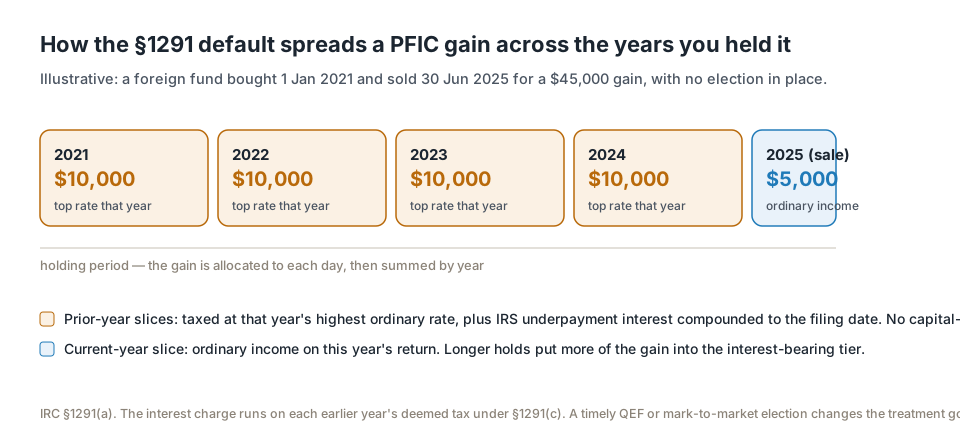
The consequence is reporting: generally one Form 8621 per PFIC, per year, and without a QEF or mark-to-market election the default §1291 regime applies — gain/excess distribution taxed at the highest ordinary rate for each allocated year, plus an interest charge.