Three return years
The most recent three years for which the return due date (or properly extended due date) has passed, with complete delinquent or amended returns and required information returns.
For US citizens and green-card holders abroad who are behind on returns or FBARs and whose failure may have been non-willful, the IRS procedure is the structured route back: three returns, six FBAR years and a signed certification. Atamatax screens the fit for free, then prepares the years — you sign Form 14653 and file.
Free screening, two minutes, no account · No automatic eligibility decision · No filing submission
Start here
The Streamlined procedures are defined by the returns that are missing, so that is where an assessment starts. One question to begin, three more to sharpen it, no email — and your answers carry into the eligibility screening rather than being asked again.
Free, no account, nothing you answer leaves this page. Open the full eligibility checker
Four answers give a first read on the published gates; eligibility follows from your full facts. Non-willfulness is your own certification on Form 14653 — a statement only you can make.
Which of these is you?
They do not all lead to the same procedure, and two of them often lead somewhere cheaper than this page. Each one opens the tool that settles it.
I have never filed US taxes
The most common way people get here, and the one with the most published structure behind it. Three returns, six FBAR years and a certification you write yourself.
Check the criteria →I missed FBARs, but my returns are filed
A different route. If your income was reported and the tax was paid, you file the late FBARs with a reasonable-cause statement rather than a full three-year catch-up — the IRS withdrew its published procedures for it on July 1, 2026; the filing is unchanged.
Filed returns plus missed FBARs is usually not a Streamlined case.
See which route fits →I own foreign ETFs or funds
This is what decides the size of the case. Each non-US fund can need its own Form 8621 for each year it was held, so a straightforward three-return catch-up becomes a dozen forms.
Scan the portfolio first →I received an IRS or bank letter
Read it before doing anything else. An open IRS examination or investigation closes the Streamlined procedures entirely — a bank's FATCA letter does not, and the two are easy to confuse.
An open examination is a hard disqualifier, not a complication.
Check whether the door is still open →There is no deadline on the Streamlined procedures and nothing here is counting down. These are the reasons that are actually true, and the smallest thing each one asks of you.
The foreign procedure asks for the most recent 3 years of returns and the most recent 6 years of FBARs — counted from the years whose due dates have passed. Waiting does not add years to that set; it moves which years are in it.
Do this: Write down the last year you filed. It is the single fact that decides the shape of everything else, and it is the first thing any route will ask for.
The published route closes once the IRS has opened a civil examination for any year, or a criminal investigation. That is the actual rule — an ordinary notice does not close it, and neither does a letter from your bank.
Do this: If anything has arrived from the IRS, find its notice or letter number. The letter names what it is, and that is what decides whether this route is open.
The records are the part that gets harder, not the rules. Foreign banks close dormant accounts, brokers purge old statements, and employers abroad are not obliged to keep foreign payroll records indefinitely.
Do this: Download what your current bank and broker still show online. Year-end and peak balances are what the FBAR years need.
Your own annual deadline is a separate question from the status of the procedures, and the two get confused constantly. One is about this year's return; the other is about the years you missed.
Do this: Check whether this year's date applies to you at all — it depends on whether you filed an extension, and it has nothing to do with the catch-up.
Direct answer
The Streamlined Foreign Offshore Procedures are IRS filing instructions for eligible taxpayers residing outside the United States who need to correct failures involving foreign financial assets and whose failures resulted from non-willful conduct.
They are not an approval application. The IRS does not pre-clear the facts, and the submission does not produce a closing agreement. The taxpayer submits complete returns, FBARs and Form 14653 under the published terms and remains subject to examination.
When an eligible submission satisfies those terms, the foreign procedure states that the listed failure-to-file, failure-to-pay, accuracy-related, information-return and FBAR penalties will not apply. Tax and statutory interest still have to be paid. That treatment should not be reduced to a calculator verdict because eligibility and non-willfulness are fact-dependent.
From where you live
Yes, in principle: the foreign procedure is written for taxpayers residing outside the United States, and the country is not one of its gates. What the country changes is the content of the submission — which local accounts count toward the FBAR, and which local investment wrapper adds a Form 8621 to every open year. Each desk below states that in one sentence and continues into the catch-up route for that country.
Dutch bank, savings and brokerage accounts count toward the FBAR aggregate whatever Box 3 already taxed, and a Dutch or UCITS fund adds a Form 8621 to every open year — which is usually what turns a simple catch-up into a tiered one.
A Girokonto, Tagesgeld, Depot and most Bausparverträge count toward the FBAR aggregate, and the Abgeltungsteuer already withheld satisfies nothing on the US side; an ETF-Sparplan adds a Form 8621 to every open year.
Spanish bank and brokerage accounts count toward the FBAR aggregate and a Modelo 720 filing does not satisfy it; a fondo de inversión or a Spanish-listed UCITS ETF adds a Form 8621 to every open year.
French current accounts, the livrets, a PEA and an assurance-vie (a cash-value contract is an FBAR account) all count toward the FBAR aggregate; the funds inside a PEA or an assurance-vie are commonly PFICs, which adds a Form 8621 to every open year.
Swiss bank, PostFinance and pillar 3a accounts count toward the FBAR aggregate, and a fund-based pillar 3a or a UCITS ETF adds a Form 8621 to every open year — the count of funds, not the size of the balance, is what sets the tier.
UK current and savings accounts, cash and stocks-and-shares ISAs, a SIPP and an app account held by a non-US entity all count toward the FBAR aggregate; the funds inside a stocks-and-shares ISA are commonly PFICs, which adds a Form 8621 to every open year.
Canadian bank accounts, a TFSA, an RRSP, an RESP and a RRIF are all foreign financial accounts for the FBAR even when their income is deferred; a Canadian mutual fund or ETF held outside an RRSP adds a Form 8621 to every open year.
Italian conti correnti, deposito titoli and Poste Italiane accounts count toward the FBAR aggregate and a Quadro RW filing does not replace it; fondi comuni and the UCITS ETFs on Borsa Italiana are commonly PFICs, which adds a Form 8621 to every open year.
Living somewhere else? The procedure is the same; the country desks cover the local products, and the eligibility check does not ask where.
One procedure, many names
The IRS calls it the Streamlined Foreign Offshore Procedures — the foreign half of the Streamlined Filing Compliance Procedures. Americans abroad call it the streamlined procedure for expats, streamlined filing, catching up on US taxes from abroad, or simply filing late US tax returns from overseas. An FBAR catch-up is usually part of the same submission: six years of FinCEN reports go in with the three years of returns and the Form 14653 certification of non-willful conduct.
It is a filing procedure for US citizens and green-card holders living abroad, not an amnesty programme and not the “foreign disclosure program” people sometimes search for — that phrase covers several IRS routes, of which this is the one for non-willful taxpayers outside the United States. If your returns are filed and only FBARs were missed, the narrower late-FBAR route may apply instead — the IRS withdrew its published procedures for it on July 1, 2026, and that page says what changed.
Current status · checked October 6, 2026
No IRS-announced end date is currently published. The IRS continues to publish active Streamlined Filing Compliance Procedure instructions, while its manual reserves the right to discontinue the procedures at any time.
The IRS Internal Revenue Manual also says the Streamlined procedures may be discontinued at any time. That is a standing reservation, not evidence of a scheduled shutdown. We do not use it to manufacture urgency: verify the current IRS instructions when you are ready to file, and choose timing based on your facts and filing obligations.
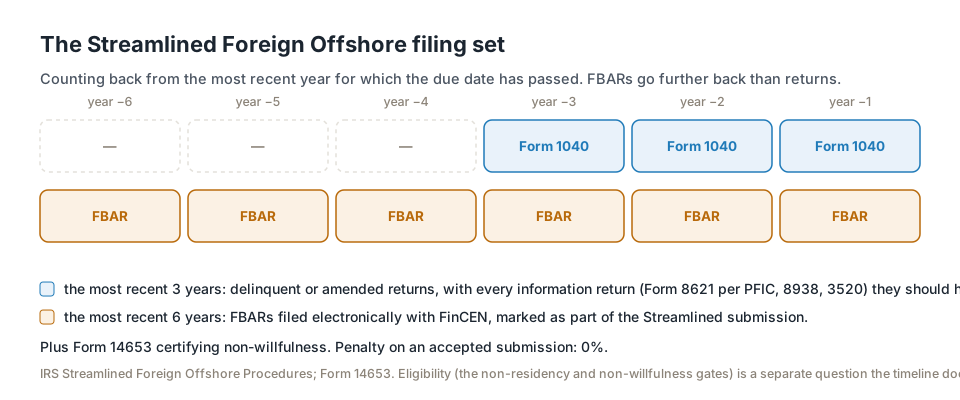
The standard submission set
The most recent three years for which the return due date (or properly extended due date) has passed, with complete delinquent or amended returns and required information returns.
The most recent six years for which the FBAR due date has passed, filed electronically with the Streamlined filing explanation.
A signed certification that addresses eligibility and non-willful conduct, including a factual narrative in your own words.
Any tax due on the submitted returns plus statutory interest. The favorable penalty terms depend on eligibility and a complete, accurate submission.
Foreign investments change the workload
A foreign brokerage account may create an FBAR and Form 8938 question. The securities inside it are a separate analysis: non-U.S. ETFs and mutual funds may be PFICs, and each affected holding can require its own Form 8621 for each relevant return year.
Before preparing the set, inventory every fund by name and ISIN, acquisition date, basis, distributions, sales and election history. Atamatax routes multiple potential PFICs to a higher-complexity review rather than treating them like one account line.
Common complexity triggers
Non-U.S. ETFs, mutual funds and some pension or savings wrappers can add Form 8621 or treaty questions to every affected year.
An interest in a foreign company, trust or a large foreign gift can bring Forms 5471, 3520 or 3520-A into the submission.
Business income raises self-employment tax and totalization-agreement questions alongside the income tax itself.
Filing status, a missing ITIN and each spouse's own non-residency test all change what the joint or separate package looks like.
When a professional should look at the facts first
None of these automatically rules the procedure out. They are the facts where the choice of route, and the wording of the Form 14653 certification, is a judgment for a tax professional or attorney you engage — not for a screener.
Preparation workflow
Review U.S. status, non-residency, examination history, the nature of the filing failure and whether returns or only FBARs are missing.
Identify the three return years, six FBAR years and every international information return that belongs with them.
Gather returns, wage and tax statements, maximum account balances, brokerage statements, acquisition data and fund documentation.
Prepare each return and FBAR, resolve PFIC or other foreign-asset gaps, draft the factual certification and review the complete package before submission.
What Atamatax prepares · what it costs · what happens next
Every Streamlined package prepares the three return years and the six FBAR years and ends with a completeness check. You sign Form 14653 and file. The packages differ by what sits inside the years — wages and bank accounts, or foreign funds, or entities and trusts — and each is quoted in writing once the scope is confirmed, never bought blind.
Streamlined Essential
$1,590
Behind on filings, with wages, pensions or bank accounts — no foreign funds or ETFs.
Streamlined Investor
$2,200
Everything in Essential, plus foreign brokerage accounts and fund holdings.
Streamlined Complex
From $2,990
Many PFICs, corporations, trusts, multiple jurisdictions, or unusual treaty issues.
Published prices, $1,590–$2,990+ depending on scope. The full deliverable list and what can change a price are on the pricing page. If you are comparing a law firm with a preparation service, see our Golding & Golding fee and scope comparison.
After the free check
Confirm the scope
Which years are open, which of them need a return, an FBAR or both, and what has to be gathered for each. Free, and it is the step a price can be written from.
Receive a written quote
A fixed package with the years it covers, the adjustments that apply to your case, what is excluded, and the total. It arrives in your case file, not in a conversation, and it is yours to read before you decide anything.
Accept and pay
Accepting the quote opens a secure Stripe checkout for that quote. Card details are entered on Stripe and never on Atamatax. Nothing is charged until you accept.
Prepare the documents
A personalized checklist opens against your case. You upload; each item is reviewed before it is accepted.
A call is free, optional and available at any point. Where the scope needs a conversation — an open willfulness question, an IRS examination, or facts the intake leaves open — it is offered before any price; otherwise the written quote comes straight from the intake.
Who does what
Software prepares
The engine reads your entries, computes the figures for the year, maps each one to an IRS form line and lists the assumption behind it. The on-screen result comes before any payment.
How the figures are workedA person checks
A person at Atamatax checks each package for completeness before it is released. That check is operational: it confirms the package is whole, and leaves the tax positions in it to you and the professional you choose.
The exact scope of the checkYou review, sign and file
Every form is signed by you and filed by you — the return with the instructions in the package, the FBAR on FinCEN's site. The package is complete when you have done both.
The whole path, step by stepJudgment stays with a professional
Whether conduct was non-willful (your certification on Form 14653), a treaty position, an expatriation decision, an open examination — these are calls for a professional you engage, with the Atamatax package as their starting point.
Where your data livesDocuments to gather
Atamatax provides tax preparation support and educational resources. This website does not constitute legal or tax advice.
Streamlined · FAQ
Primary sources (Cornell Legal Information Institute for the US Code and CFR; IRS.gov for forms, procedures, and treaty documents). This page is general information, not individualized tax or legal advice.
By country
The non-willfulness and non-residency gates are the same everywhere. The years of missed Form 8621s tend to look different depending on what you were holding — and where.
Free preliminary result · a few questions
Answer a few questions about the years you missed and what you hold abroad. See which filings may apply, whether the Streamlined route looks consistent with your facts, and what to gather first.
SEO answer → case qualification
Start with the cautious checker. Straightforward potential fits can create a preparation workspace; multiple PFICs or other foreign-investment complexity route to a scoped case review. No result silently purchases a service or certifies eligibility. Preparation packages are published at $1,590–$2,990+ depending on scope — the prices are on the pricing page, not behind a quote call.