Bank accounts
Checking, savings and time deposits at any non-US bank, whatever the balance of the individual account.
If your non-US financial accounts together crossed $10,000 at any point in the year, you generally have to file FinCEN Form 114 — even when you owe no US tax at all. Here is what counts, what it is not, and what to do about missed years.
Free threshold check · No signup · Sources cited on every figure
Check it for your own accounts
Three questions, no balances typed, no email. The read explains the aggregate rule — the part most people get wrong — and what would settle the rest.
Free, no account, nothing you answer leaves this page. Open the full FBAR / Form 8938 checker
A threshold screen, not a filing determination. Three answers cannot establish whether a specific account is reportable; the full checker and the account's own terms can.
The short answer
The FBAR — Report of Foreign Bank and Financial Accounts, filed as FinCEN Form 114 — is how a US person reports non-US financial accounts to the Financial Crimes Enforcement Network. It is not part of your tax return, it is not filed with the IRS, and it does not itself impose any tax.
You generally file when the combined value of your non-US accounts exceeded $10,000 at any point during the calendar year. Two details trip people up. First, it is a combined test across every account, not a per-account one. Second, it is the peak balance, not the balance on 31 December — so money that passed through an account and left still counts.
Because it is an information report rather than a tax form, the obligation is completely independent of whether you owe anything. Most Americans abroad owe no US tax after the foreign earned income exclusion and foreign tax credits, and a great many of them conclude — reasonably but incorrectly — that this means there is nothing to file.
For a non-willful failure to file one compliant annual FBAR, the Supreme Court held in Bittner v. United States (2023) that the statutory maximum applies on a per-report, not per-account basis. Willfulness and other penalty questions are fact-sensitive. Current figures: $16,536 for non-willful violations and $165,353 where willfulness is established.
Scope
The test is about where the account is held, not about what is inside it or what currency it is in. A non-US brokerage account holding only American stocks is still a foreign financial account.
Checking, savings and time deposits at any non-US bank, whatever the balance of the individual account.
Non-US securities accounts, including ones holding only US stocks. The account is foreign even when its contents are not.
Revolut, Wise, N26 and similar, where the account is held with a non-US institution.
Some occupational and vested-benefits accounts are reportable; treatment depends on the specific arrangement.
Signature authority counts — an employer or family account you can direct is reportable even if you own none of it.
A joint account is generally reported in full by each US person on it, not split by ownership share.
Treatment of specific pension, insurance and vested-benefits arrangements depends on how the product is structured. This is general information, not advice for your facts.
The full FBAR guide
Threshold, deadline, and how the FBAR differs from the FATCA form people confuse it with.
Bank, brokerage, fintech and pension accounts — the ones people forget are reportable.
The same rules, against the accounts people actually hold locally.
Missed years are common and there are established catch-up paths.
FBAR · FAQ
Primary sources (Cornell Legal Information Institute for the US Code and CFR; IRS.gov for forms, procedures, and treaty documents). This page is general information, not individualized tax or legal advice.
By country
The $10,000 combined-peak threshold is the same everywhere. Which accounts count, and what your bank calls them, is the part that differs by country.
Free preliminary result · a few questions
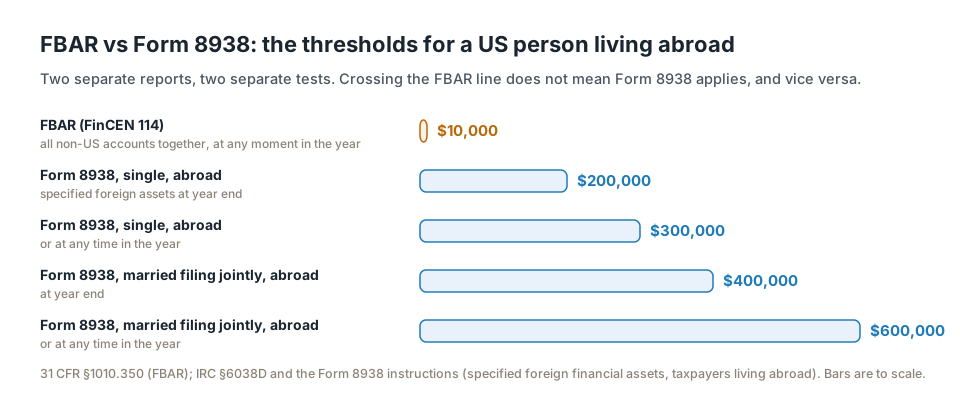
The FBAR and Form 8938 have different thresholds, different definitions and different penalties. A few questions show which one — or both — your accounts point at, and what else rides along.
Atamatax · FBAR
Enter your balances and filing status — the free checker shows whether you cross the FBAR threshold, the Form 8938 thresholds, or both. Nothing is saved and no account is needed.